From AI Capability Validation to Scaled Enterprise Value
The enterprise AI journey is not linear. Different business capabilities can sit at different maturity stages simultaneously – from early-stage experimentations and proof-of-concepts, through operationalisation, to emerging agentic AI adoption.
While many enterprises have successfully validated AI concepts and their potential value, far fewer have translated them into sustained business impact at scale and integrated them into real-world operations. As organisations move towards making their AI platforms and ecosystems enterprise-scale ready, the challenge is no longer simply experimentation. The focus now is on building holistic, reusable capabilities that are embedded across the enterprise rather than delivered as isolated IT projects.
The next real question then becomes: how do we consistently convert platform capability into realised business value over time?
The Enterprise Value Realisation Framework: Two Core Dimensions
- Strategic foundation: selecting the right platform and ecosystem that integrates across enterprise architectures and supports long-term scalability.
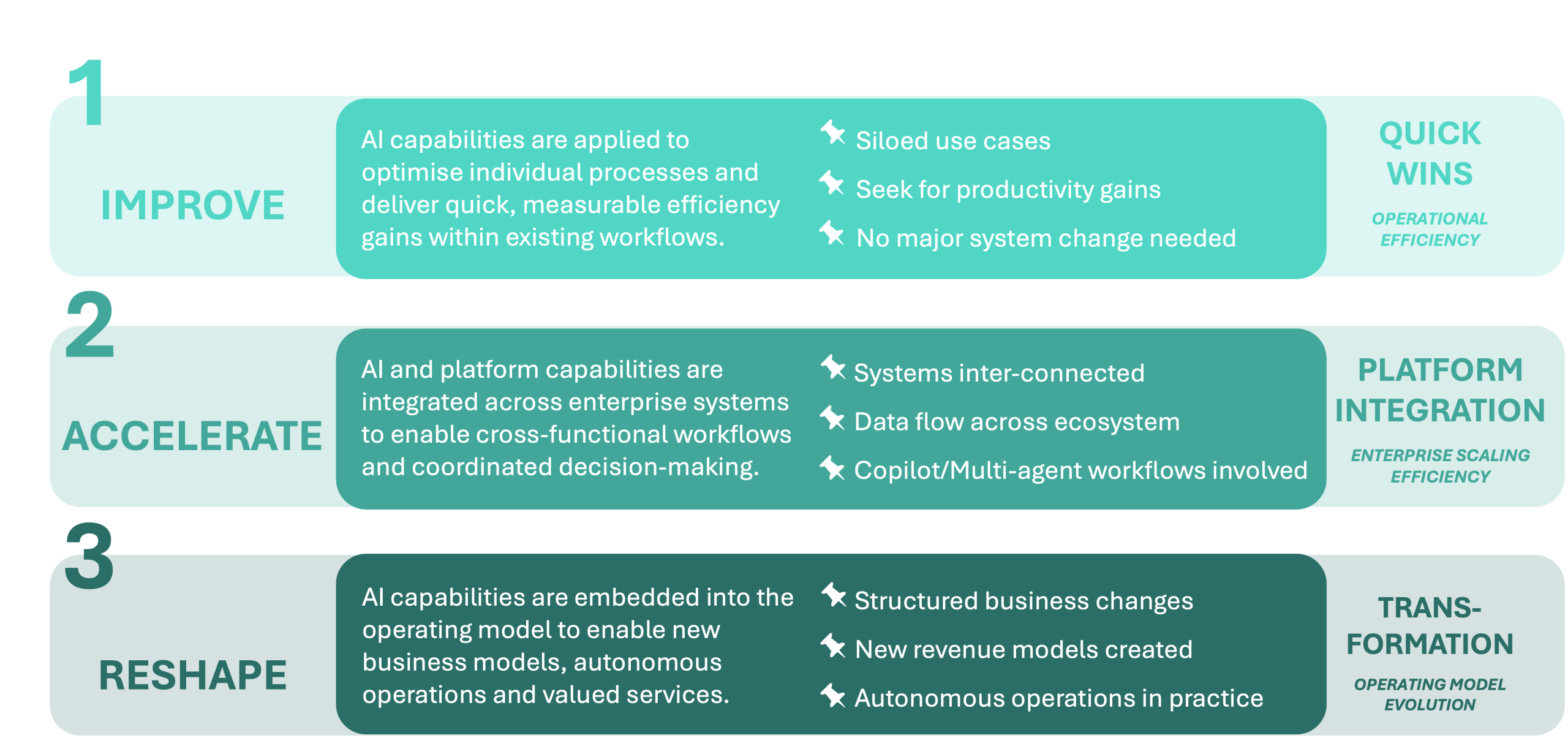
- Value realisation aligned to enterprise maturity: understanding where the organisation as a whole – from enterprise operations to individual business units – is on its transformation journey and prioritising initiatives as an interconnected set of stages across three value realisation stages: Improve, Accelerate, and Reshape.
The following framework illustrates the three stages of value realisation.
Applying the Framework: Considering a Manufacturing Enterprise Scenario
Global manufacturing investment decisions are increasingly shifting beyond pure cost optimisation toward broader geoeconomic readiness and resilience factors, as highlighted in the World Economic Forum’s Beyond Cost analysis1.
Consider a global industrial manufacturing enterprise at the beginning of its AI-enabled transformation journey, where day-to-day operations span production planning, supply chain coordination, predictive maintenance, and quality assurance across the global operations that run across time zones.
The World Economic Forum’s Beyond Cost analysis also highlights that the industry’s globalisation model is increasingly transforming towards a digitally enabled, regional-for-regional systems to balance efficiency with resilience.
1. Improve – The Operational Efficiency Stage For Quick Wins
AI is initially applied within the manufacturing industry to optimise discrete operational processes such as predictive maintenance of machinery, automated quality inspection on production lines and demand forecasting for inventory planning. These targeted use cases deliver immediate efficiency gains without requiring changes to the underlying operating model, while delivering measurable efficiency gains within existing workflows.
2. Accelerate – The Platform Integration Stage For Effective Cross-Functional Collaboration
As maturity increases and industry strategies awareness shifting, AI and data platforms are integrated across production, supply chain and enterprise planning systems. This enables cross-functional workflows where manufacturing, logistics and procurement teams operate on shared real-time data with the data flow across ecosystem become accessible. Copilot assistants, multi-agent and AI-driven automation workflow coordination are integrated that improve the business’s end-to-end visibility and empower coordinated human-AI decision-making across the enterprise.
3. Reshape – The Transformation Stage For Operating Model Evolution
At the highest level of maturity, AI becomes embedded into the core operating model of the enterprise. Production systems increasingly optimise themselves autonomously, while the organisation shifts towards outcome-based service offerings such as equipment-as-a-service or performance-based manufacturing contracts. This represents a fundamental change from a product-centric to a service- and outcome-driven business model.
At the ultimate level of enterprise-wide AI maturity, AI becomes embedded in the core operating model itself, enabling a shift from product-centric business models to valued based services offerings, as well as autonomous optimisation of production systems. For example, carbon-accounting-based pricing, regionalised supply chain orchestration and performance-based manufacturing contracts supported by agents.
From Platform Foundations to REALISED Sustainable Business Transformation
This value realisation model builds upon the enterprise-scale AI architecture discussed in the previous article, Beyond AI Pilots: Building and Operating Enterprise AI That Lasts2
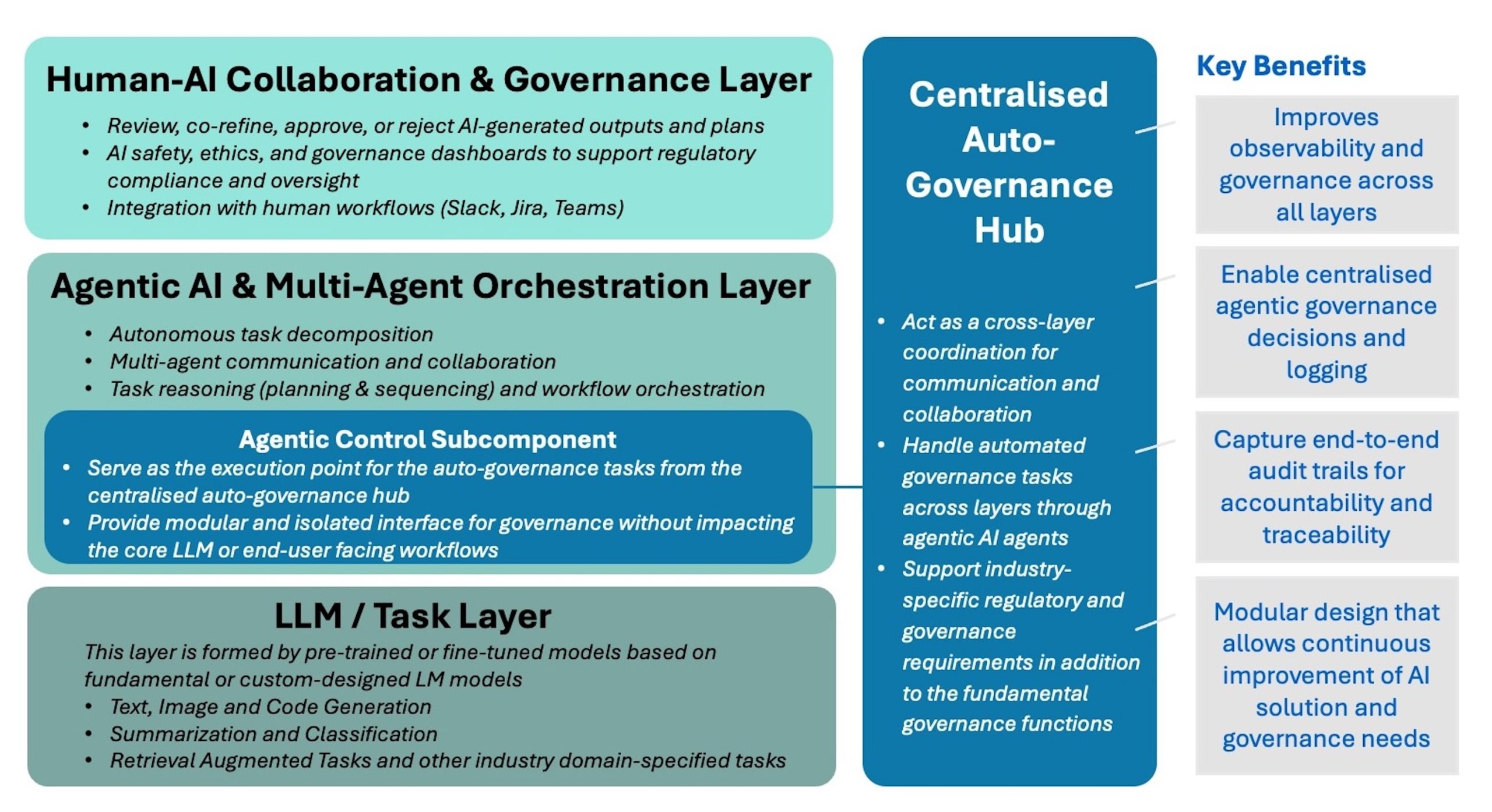
Enterprise AI Value does not emerge from the platform alone. It emerges when the right foundations – architecture, data, AI capabilities, operating models and business priorities – evolve together and progressively change how the organisation operates, makes decisions and creates both operational and new business value.
With the right platform foundation, enterprise can continuously evolve their transformation journey – creating new data-driven insights, enabling new operating models, business opportunities and sources of competitive advantage.
The objective is therefore not simply to build an AI subsystem or delivered project by project. This is only the starting point. The key to sustainable business transformation is to build with a strong foundation, scale flexibly and progressively in the entire business ecosystem that can continuously evolve the enterprise capabilities to sustain long-term business value realisation. The organisations that succeed will not simply deploy better AI – they will become better at continuously transforming themselves.
Reference:
- The World Economic Forum’s White papers, “Beyond Cost: Country Readiness for the Future of Manufacturing and Supply Chains,” 10 December 2024 ↩︎
- Beyond AI Pilots: Building and Operating Enterprise AI That Lasts ↩︎