Align, Measure, Evolve – Move Fast Without Losing Control
Organisations are facing intense pressure to move AI from ideas into production-ready solutions rapidly. Yet with the rapid advance developments in AI, cloud platform and tools, many innovation initiatives still fail hit a roadblock for some familiar reasons. Across more than 20 years working in early-stage technology and initiatives roles spanning tech start-ups, R&D environments, and multinational enterprise organisations prior to founding Techzymic Innovations, I have observed similar patterns repeat when teams struggle. This article discusses the evolving principles on innovation delivery – what works and what doesn’t work – in the AI era.
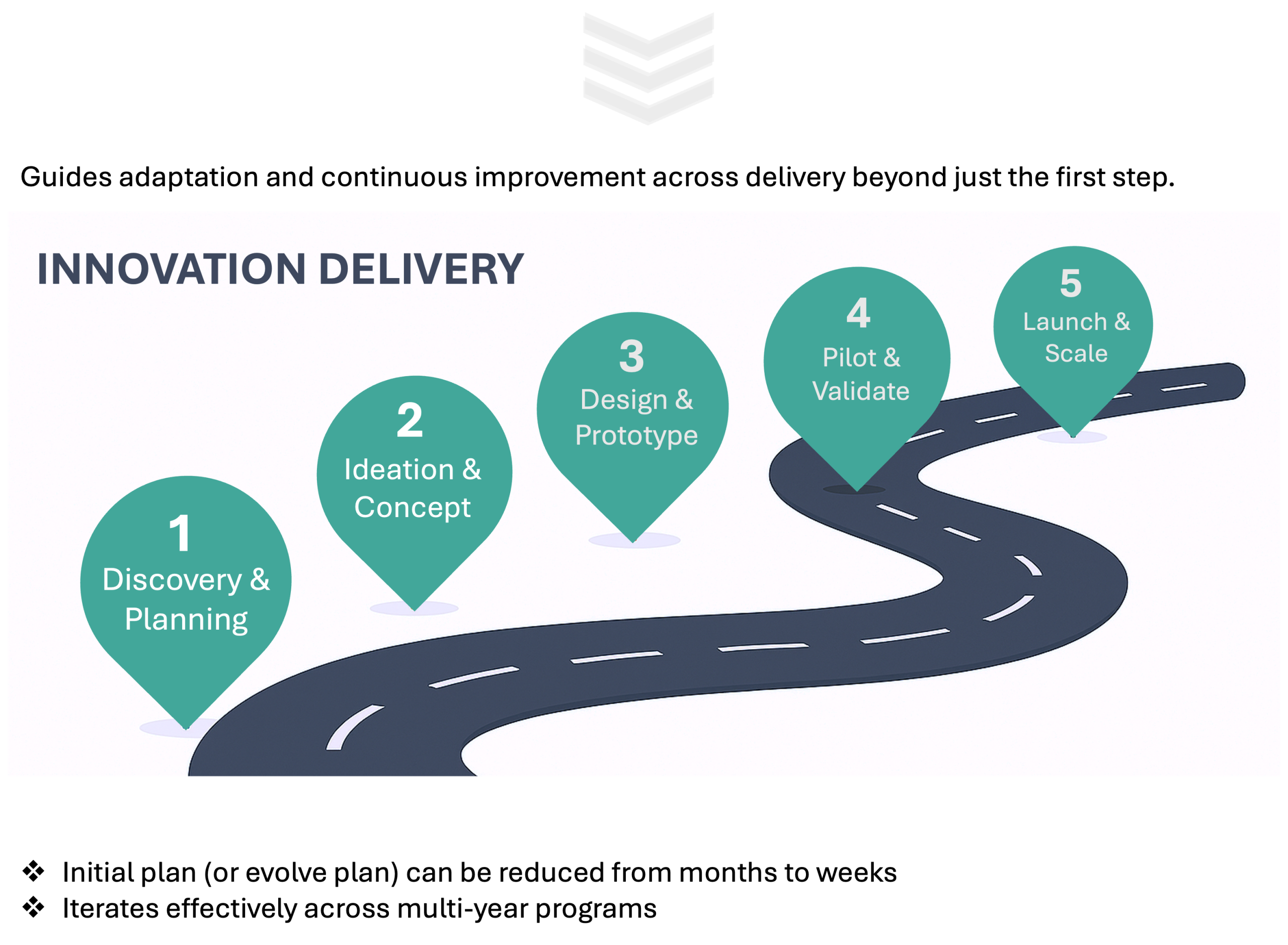
These insights focus on the first critical step of innovation delivery: the early-stage work where ideas are shaped into executable outcomes.
Why Innovation DELIVERY Isn’t STRAIGHTFORWARD
With faster prototyping enabled by modern tooling, including AI-assisted development such as Claude Code and GitHub Copilot, the challenge is no longer just building solutions – it is ensuring teams are solving the right problems and making evidence-driven decisions early. Modern AI tooling can accelerate product development and provide insights, but success still depends on human judgment, alignment, and decision-making. Recognising both the assets AI brings – and the gaps that remain – is critical for leading innovation delivery effectively.
From deep-tech research labs to product-led emerging technology development and enterprise programs, I have witnessed funding cycles, shifting priorities, organisational cultures, team dynamics, and technology complexity collide, creating “clouds of confusion” that obstruct or even stall promising ideas.
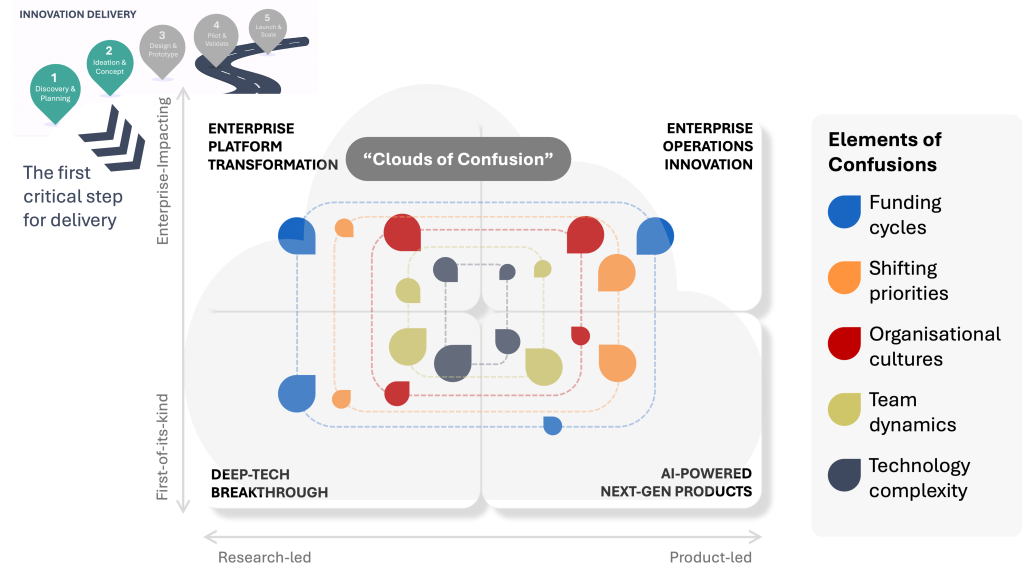
Innovation – whether in digital transformation, deep technology breakthrough, product, process or operational advancement type – is not just about ideas or technology. It is about guiding teams through uncertainty to deliver working solutions.
Navigating Common Pitfalls: People, Process, Technology
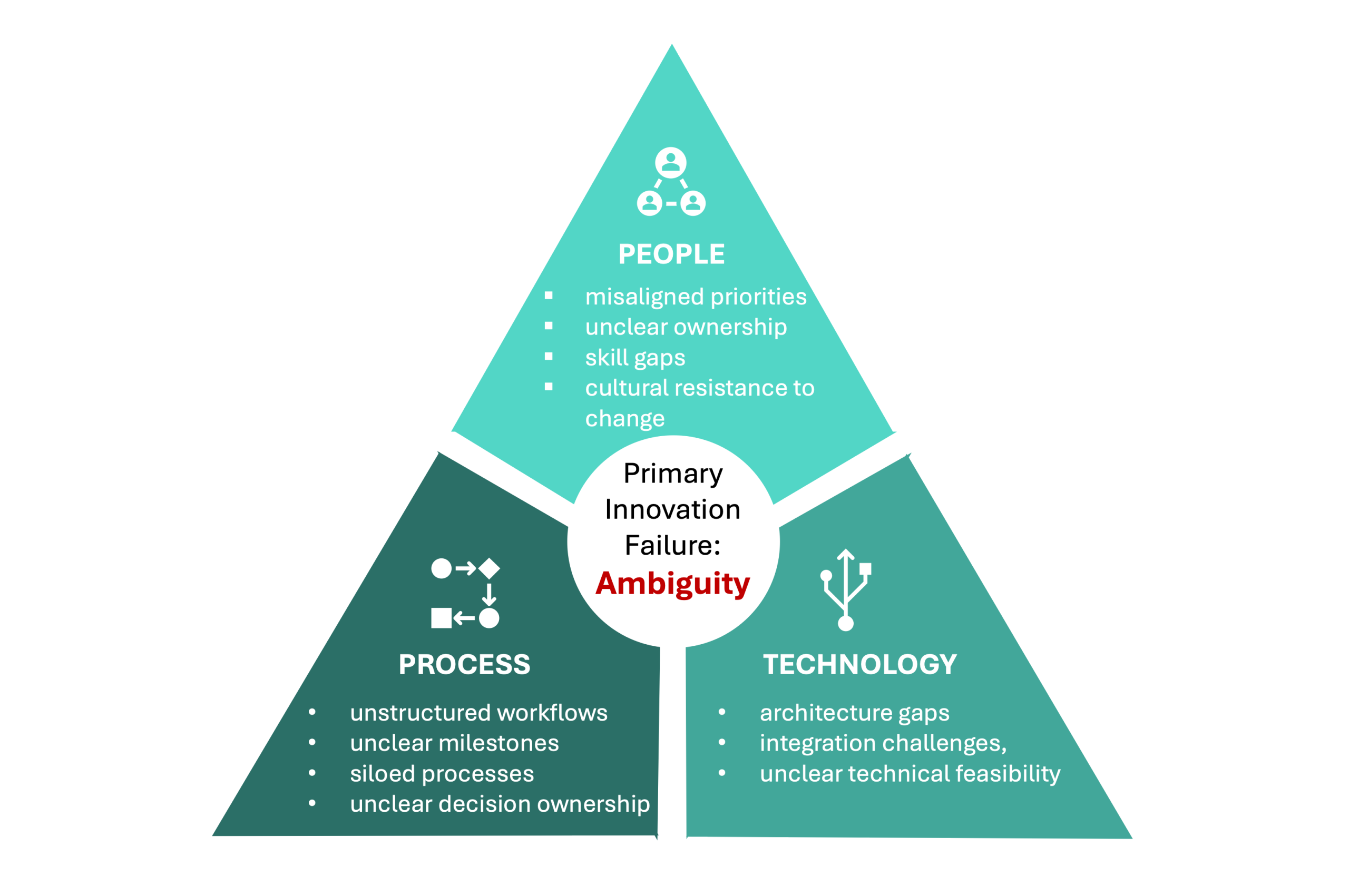
Across working on various initiatives, I have noticed three repeating barriers that block most often:
- People – misaligned priorities, unclear ownership, skill gaps, cultural resistance to change
- Process – unstructured workflows, unclear milestones, siloed processes, and unclear decision ownership
- Technology – challenges on system architecture or integration gaps, unclear technical feasibility
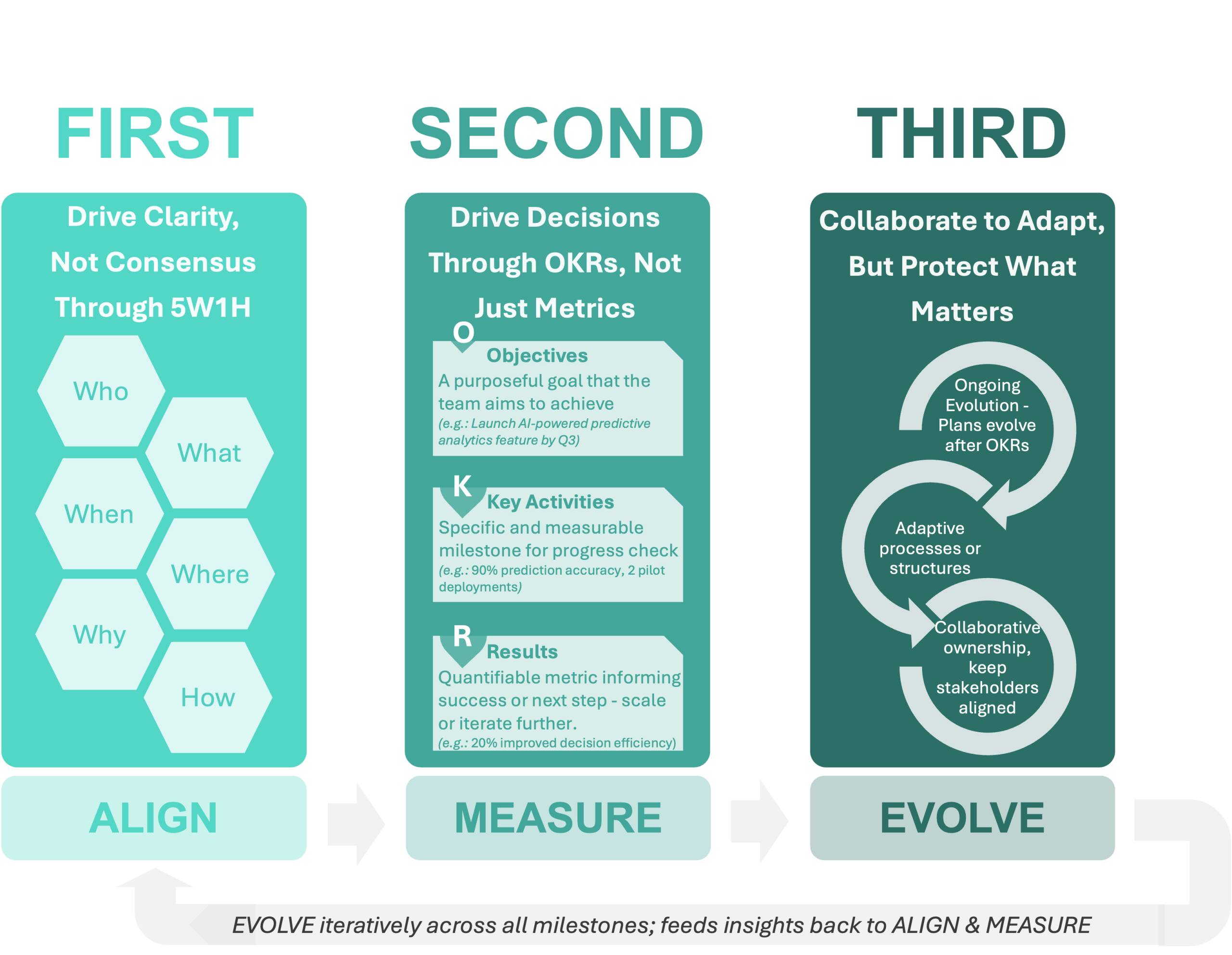
FIRST: ALIGN – Drive Clarity, Not Consensus Through 5W1H
The double diamond design thinking1 approach is widely used in innovation, with the first diamond focused on discovering and defining the problem, and the second diamond on developing and delivering solutions. While valuable, in complex or cross-cultural environments, the first diamond can lead to extended discussions without clear decisions and eventually stall the progress.
In these scenarios, applying the 5W1H framework (Who, What, When, Where, Why, How) helps teams cut through ambiguity and clarify objectives quickly without unnecessary discussion, so teams focus on what truly matters.
“In early-stage product initiatives, engineering and business teams often interpreted goals differently. Using 5W1H, we clarified the core problem, target users, and delivery responsibilities, enabling teams to prioritise milestones and move from discussion to execution efficiently. 5W1H helped teams move forward faster when other frameworks became overly complex“
In reality: Use 5W1H to enable movement faster and more direct, but not to eliminate all uncertainty. The key of ALIGN is to not consensuses but achieve sufficient clarity to move forward.
SECOND: MEASURE – Drive Decisions Through OKRs, Not JUST Metrics
Ambiguity can be further reduced by defining Objectives and Key Results (OKRs) early. OKRs translate strategy into measurable outcomes, help prioritise resources, and track progress against results that matter – not just activity.
“In a cross-functional initiative I was involved in, introducing OKRs early in the process allowed the team to focus on high-impact milestones rather than scattered experimentation. When teams measure outcomes that matter, innovation efforts become significantly more focused and transparent.”
In reality: Use OKRs can get trapped into activity progress, rather than driving the right decisions. The key of MEASURE is to focus on decision-driven outcomes, but not just metrics for quantified measures and program tracking.
THIRD: EVOLVE – Collaborate to Adapt, But Protect What Matters
The delivery’s planning work doesn’t stop after OKRs are set. Plans will inevitably evolve. Collaborative ownership ensures teams stay agile while aligned.
Leadership for these types of delivery programs is not about enforcing a rigid plan. It is about creating structures that allow teams to adapt while remaining aligned on outcomes.
“In several initiatives I led, I guided iterative roadmap adjustments while keeping stakeholders aligned and projects on track.”
In reality: Things will evolve, but not everything should. Without clear boundaries on what can and cannot change, teams will fall into endless confusion. The key of EVOLVE is to focus on what must remain stable while letting the rest adapt.
Workflow FOR DRIVING SUCCESSFUL DELivERY
While change is constant in innovation development, there is a consistent pattern. From my own experience, innovation programs could succeed most effectively when guided by these three core principles:
- ALIGN: Apply 5W1H – but drive clarity, not consensuses.
- MEASURE: Define with OKRs – but focus on decisions-driven outcomes, not progress metrics.
- EVOLVE: Adapt collaboratively as conditions change – but protect what must remain stable.

What Keeps Your Initiatives On-Track?
AI has changed how we build solutions, but it has not changed what successful criteria where organisations need: clarity of purposed, focused execution, and the ability to adapt. The organisations that combine human judgment alongside AI-assisted tooling at the right decision points – what to ALIGN, MEASURE and EVOLVE, and what not to – will be the ones that able to timelessly turn innovation in uncertainty into enterprise impact.