Enterprise AI has entered a new phase, transitioning from innovation initiatives into enterprise execution, conversations in the enterprise meeting rooms are shifting from “what if we can build…?” to “what does it really takes to scale Enterprise AI?” This shift is defining the next agenda for AI services at enterprise-scale: deploying production-ready AI-powered systems that are safe, reliable, and embedded into business operations. The challenge has shifted from experimentation to operationalisation, and that changes everything.
Research revealed 58% of enterprises are actively pursuing agent capabilities1, While Generative AI is delivering value, its impact is uneven – 46% reported no single enterprise objective has produced a “strong positive impact” while only 19% reported strong positive impact across most objectives2. Another study found that nearly half of organisations are already applying AI to decision-making, yet only a small fraction has achieved full automation3, reflecting persistent gaps in trust, governance, orchestration, and workflow integration preventing them from further enterprise-scale adoption4.
Together, these trends signal a pivotal moment: scaling AI successfully requires more than technical capability – because at enterprise scale, success is differentiated by architecture, governance, and interoperability.
What impacts from Generative AI Scaling are enterprises asking for?
Enterprises that have seen strong potential from Generative AI through validation are now asking for the next step – Generative AI operationalisation – embedding Generative AI solutions into their core operations with robust governance, end-to-end traceability, and measurable ROI. Adoption is still underway due to data/infrastructure silos, workflow integration gaps, and incomplete governance challenges, but not lack of AI capability.
Enterprises’ Key Concerns:
- Domain‑specific AI: Targeted industry solutions
- Inference & integration: Embed agentic workflows with auditability and compliance
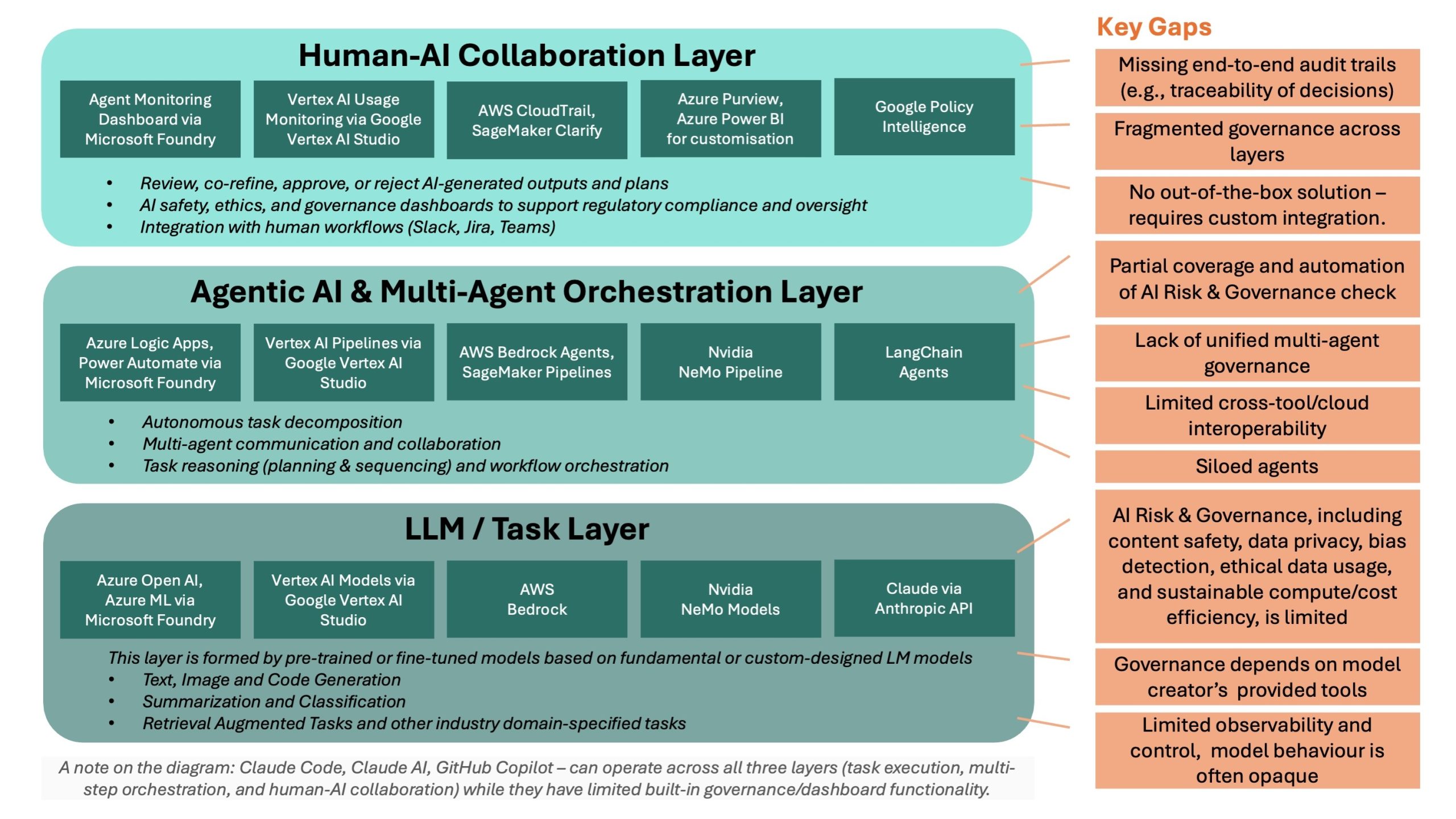
- AI Risk & Governance: Content safety, data privacy, bias checks, ethical data and models and sustainable processing (including responsible use of compute and cost efficiency)
Industry “Now → Next”:
- Financial services: pilots in customer service & fraud detection have validated value, what’s next is to focus on unifying data, scaling agentic workflows with end-to-end governance, and automate regulatory and audit process in the production systems
- Healthcare: experimentation in AI for records & diagnostics analysis shows positive impacts, what’s next is to focus on consolidating fragmented data and deploying AI-generated patient care and treatment guidance tightly with tracking for trustworthy, regulated, and governed AI processes
- Supply Chain: Inventory forecasting & route planning has generally been successful in labs, what’s next is integration with real-time operational governance, including sustainability tracking as a core ESG priority
Current Generative AI Architecture: Landscape and Gaps
At the architectural level, enterprise-scale Generative AI today generally have 3 core layers: LLM/Task Layers, Agentic AI and Multi-Agent Orchestration Layer and Human-AI Collaboration Layer.
So now, the question is – How should we now prepare enterprises?
Rethinking Architecture to Close the Gaps
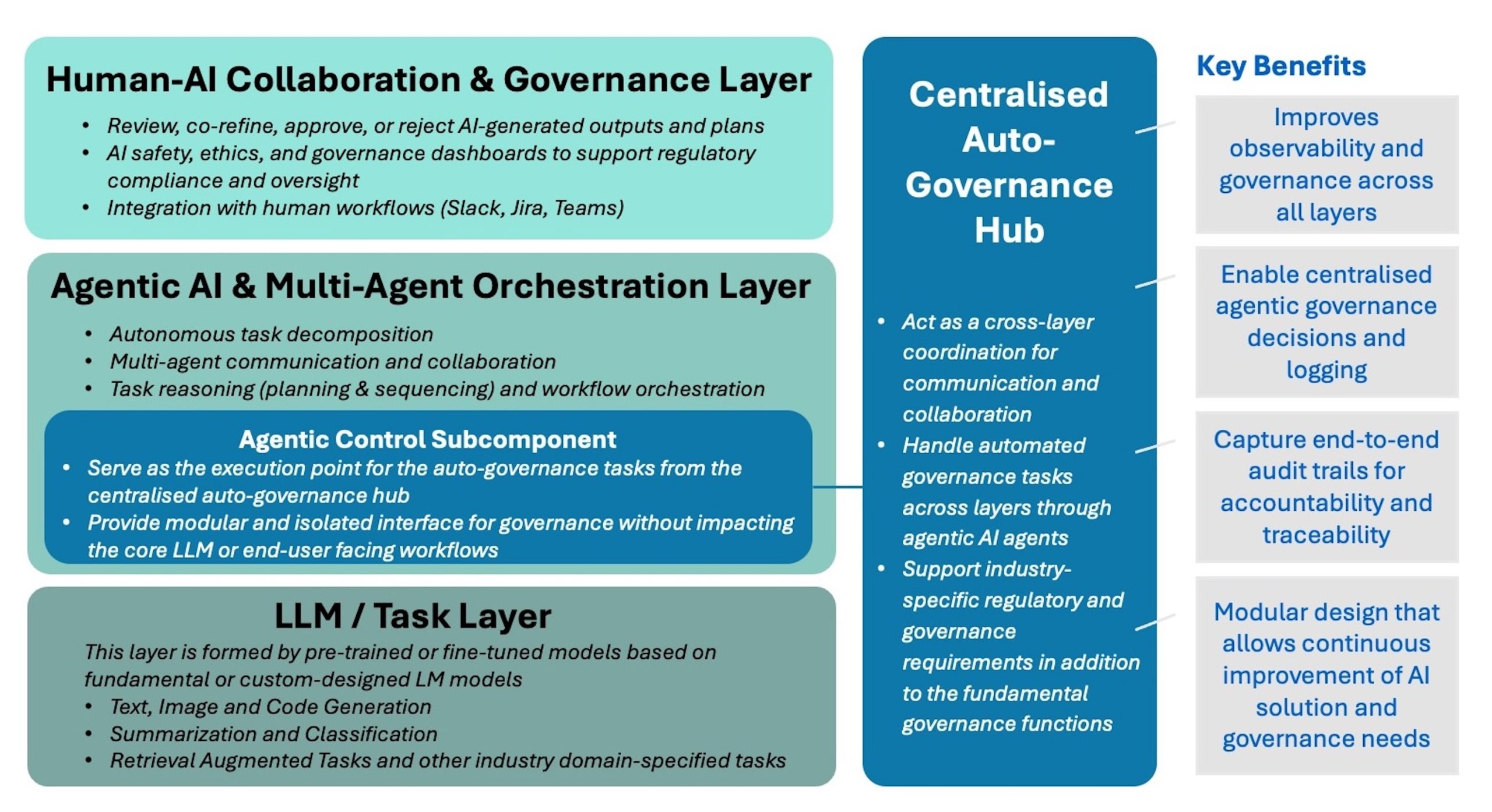
To address the current gaps, the architecture can be enhanced with two key components:
- Centralised Auto-Governance Hub:
- Act as a cross-layer coordination for communication and collaboration
- Handle automated governance tasks across layers through agentic AI agents
- Support industry-specific regulatory and governance requirements in addition to the fundamental governance functions
- Agentic Control Subcomponent added to Agentic AI and Multi-Agent Orchestration Layer:
- Serve as the execution point for the auto-governance tasks from the centralised auto-governance hub
- Provide modular and isolated interfaces for governance without impacting the core LLM or end-user facing workflows
Other Consideration – Edge AI/Cloud Integration
Edge AI is used in industries requiring controlled privacy and fast responses. Its priority is industry-dependent and specific – for autonomous devices (cars, drones, robotics), it is mission-critical due to latency, safety, and real-time decision-making constraints, while for most other industries such as healthcare, edge AI remains supportive but not immediately essential. In the near future, edge governance would represent another core gap for specific industries that may need further exploration.
In Summary
With this architecture rethinking, it builds on top of current Generative AI architecture rather than replacing, using a centralised auto-governance hub and agentic control subcomponent to provide end-to-end observability, cross-layer coordination, automated governance and compliance needs for Generative AI to bridge the enterprise-scale gaps. While it addresses these gaps structurally, implementation and operation challenges such as latency, runtime dependencies, cloud-specific optimisations, and onboarding still requires engineering efforts to fully close the gaps.
Enterprise AI: Scaling Today, Lasting Till Tomorrow
The road ahead is clear: enterprises need modular and resilient AI systems designed for long-term impact. The differentiating competitive advantages come not from adopting AI first, but from building the enterprise capabilities that allow AI to evolve resiliently and continuously. Architecture, governance, and interoperability – not individual models – will determine who leads over the next decade.
Reference:
- S&P Global Market Intelligence, “Generative AI Shows Rapid Growth but Yields Mixed Results,” October 2025 ↩︎
- S&P Global Market Intelligence, “Generative AI Digest: A Fast Start to 2026,” February 2026 ↩︎
- S&P Global Market Intelligence, “Not Quite Automatic: Decision Optimization in the AI Age Is Complex,” February 2026 ↩︎
- S&P Global Market Intelligence, “How Does the Enterprise Control Reality When AI Becomes Infrastructure?” February 2026 ↩︎